
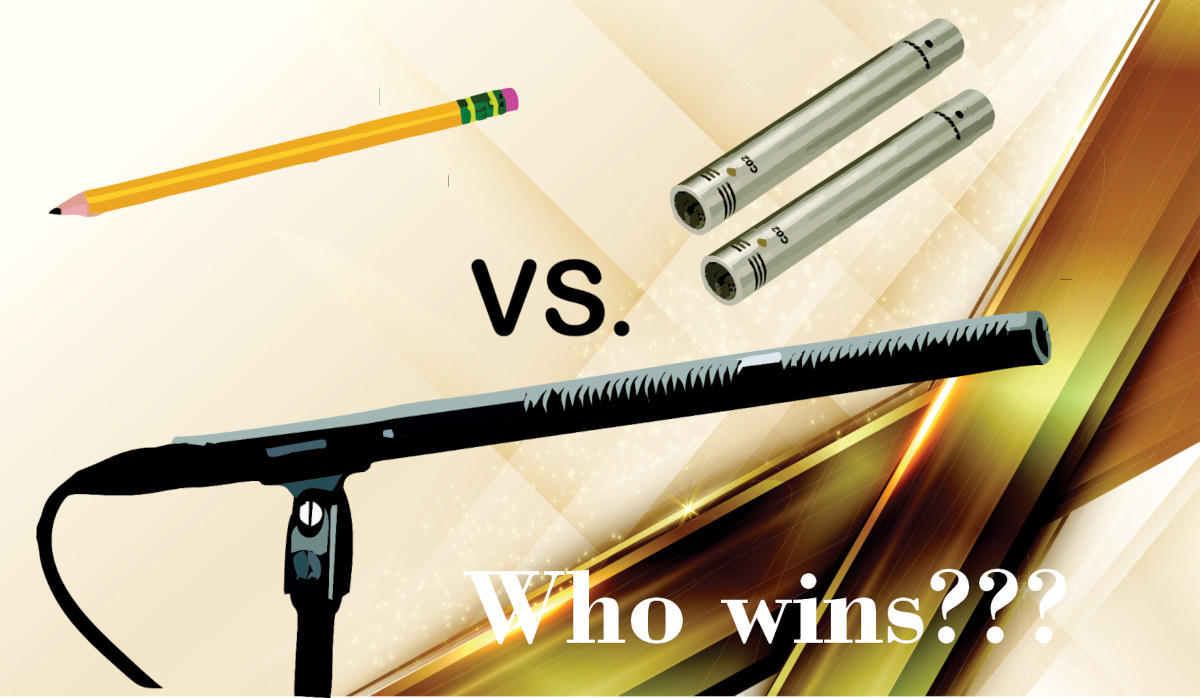
It has been said: “The pen is mightier than the sword” (Edward Bulwer-Lytton, 1839), but is the pencil mightier than the shotgun?
Have you heard that a particular type of hyper-directional microphone is as one manufacturer puts it: “…the industry standard for capturing exceptional audio with precision and clarity”. When applying that concept to Voice Over is the hype true?
Choice of microphones is a very individual concept. Each type microphone is designed for unique purposes. There are dynamic, condenser, and ribbon microphones, each converting sound into electrical signals differently. Dynamic mics are rugged, handle loud sounds, and are used for live vocals and instruments. Condenser mics are sensitive, capture detailed sounds, and are preferred for studio recording, but require phantom power. Ribbon mics offer a smooth, natural sound and are used in controlled studio environments, but can be fragile and also require a power supply. The two categories I am delving into in this article are pencil condenser and shotgun (hyper-directional condenser) style mics for Voice Over creators.
To begin with let us dismiss the idea of there being an “industry standard” microphone. Each person and voice is individual. Not one piece of equipment or for that matter: software (we will get into that topic another time); is tailored for ALL users. Microphone manufacturers want you to believe their products are designed to make your recordings sound like someone else. However, the truth is they are designed for an average, not an individual. Hence, NO industry standard.
A shotgun microphone is a highly directional audio device with a long, narrow shape, designed to pick up sound from a specific source in front of it while rejecting sounds from the sides and rear.
In most cases these microphones are used for recording a specific sound source in a noisy or busy environment where you need to reject background noise and focus on your subject. This includes situations like interviews in public spaces, on-location video shoots, live event recording, and “run-and-gun” filmmaking. The mic’s narrow, directional pickup pattern isolates the desired sound, making it ideal for situations where you need clarity and isolation.
Using a shotgun microphone in a confined environment such as a small recording booth or studio is unfavorable. I know many Voice Artists who swear by these microphones. I also know many which shy away from them as well.
Price Point: hyper-directional microphones (Shotgun microphones) are priced from under $100.00 USD to over $6,000.00 USD. Why the dramatic price difference? The quality and/or usage is a huge contrast. Lower priced HDC mics (Hyper-Directional Cardioid) are generally used on consumer video cameras. Higher priced HDC’s are often used in filmmaking for very specific sound capture.
Pencil mics are long, narrow small-diaphragm condenser microphones used for their accuracy, quick transient response, and ability to capture natural sound, making them ideal for recording acoustic instruments like guitars and drums, high-frequency sounds from percussion, and for detailed, true-to-life audio in video production and general instrument recording.
The sound of a Pencil mics is astonishingly good when placed at a longer distance from the subject being recorded. For sharp, loud, aggressive sounds the Pencil mic’s forgive much easier than their shotgun counterparts. Isolation of the subject voice is more cardioid in pattern structure and that is a very good thing in a closed studio as long as it is somewhat extraneous noise limited.
Price Point: Beginning at near $60.00 USD for a pair to over $700.00 each these Pencil’s are a good bang for your buck.
Don’t take my word on the subject. Try a pair of budget Pencil microphones for yourself and see if they fit your voice, requirements, and style. You might like them.

